

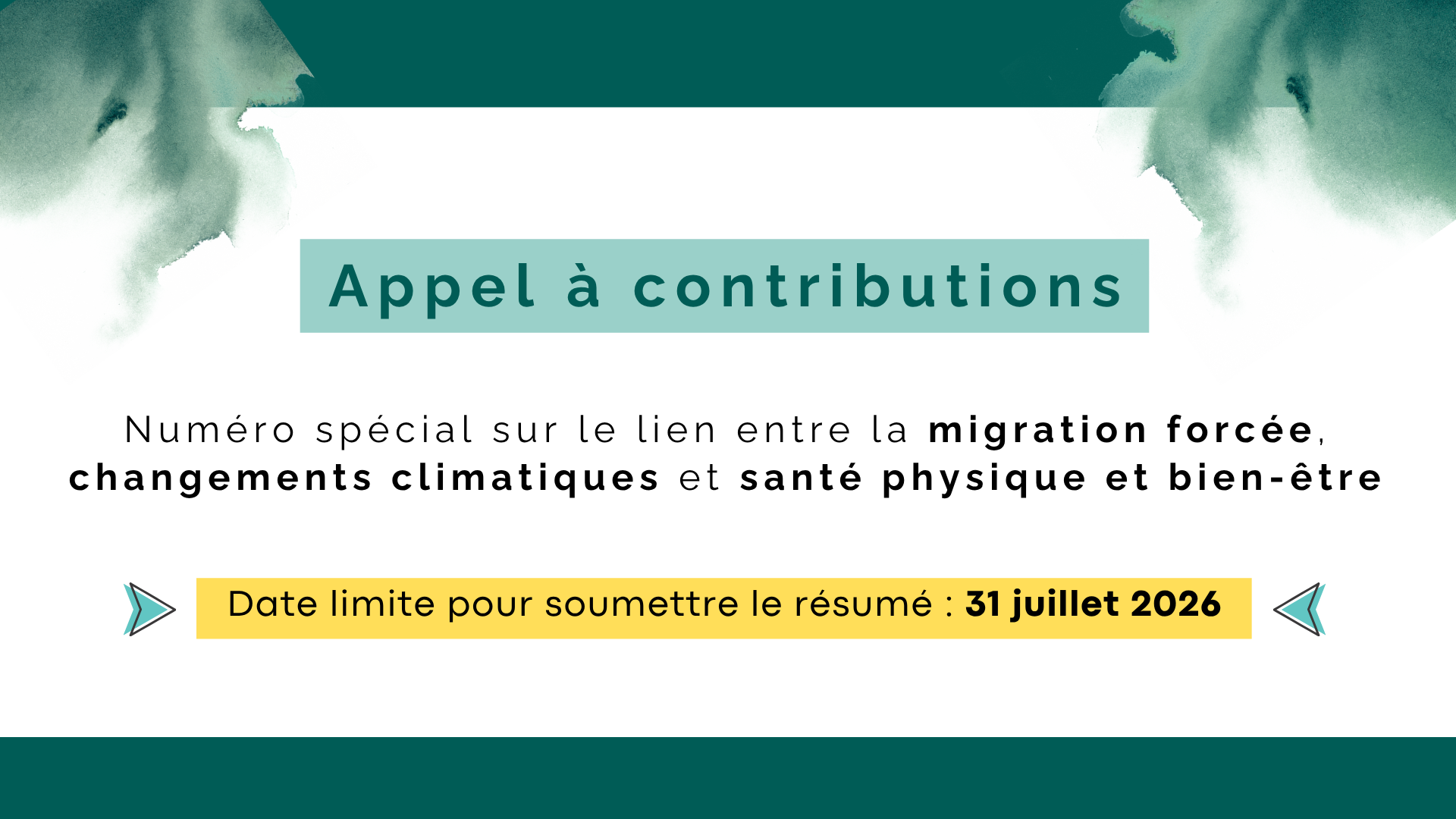
Le CERDA lance un appel à contributions pour un numéro spécial consacré aux liens entre climat, santé et migration forcée
16 juin 2026 à 8 h 00 - 31 juillet 2026 à 17 h 00- Cet évènement est passé.
Click here for English version
Le CERDA lance un appel à contributions pour un numéro spécial consacré aux liens entre climat, santé et migration forcée. Vos travaux se situent à la croisée de ces enjeux et vous souhaitez publier un article académique afin de contribuer à cette discussion interdisciplinaire? Soumettez votre résumé à notre équipe!
Nous acceptons actuellement de résumés courts (150 à 250 mots) présentant notamment :
- L’argument principal de votre contribution;
- La méthodologie employée;
- La pertinence de l’article pour ce numéro;
- Et une courte biographie.
Pour vous assurer que votre proposition concorde avec les objectifs du numéro spécial, veuillez consulter l’appel complet ici️:
Titre provisoire : Migrations forcées, climat et santé : une approche interdisciplinaire
Résumé provisoire : Ce numéro spécial explore les liens complexes entre migrations forcées, changements climatiques et santé, en adoptant une approche interdisciplinaire qui unit des disciplines diverses mais complémentaires, notamment la santé publique, les sciences sociales, la géographie et les études environnementales. Les changements climatiques ne constituent pas nécessairement une cause directe des migrations forcées. Toutefois, ils peuvent affecter la santé physique, le bien-être et les déterminants sociaux de la santé des migrants forcés à différentes étapes de leur parcours migratoire, y compris après leur arrivée au Canada.
Ce numéro rassemble diverses perspectives disciplinaires pour examiner comment les changements climatiques peuvent affecter la santé des personnes vivant la migration forcée, quelle que soit la cause sous-jacente de leur migration.
Ce numéro propose une analyse critique et intégrée des liens entre le climat, la santé et les migrations forcées, soulignant la nécessité d’adapter les systèmes et services de santé offerts aux personnes vivant la migration forcée aux réalités climatiques. Les contributions s’appuyant sur des données empiriques, sur une analyse conceptuelle ou sur une réflexion critique sur ces intersections sont les bienvenues. Les contributions peuvent être rédigées en anglais ou en français.
Vous êtes invités à soumettre un court résumé (150 à 250 mots) à Geneviève Minville (genevieve.minville.ccomtl@ssss.gouv.qc) avant le 31 juillet 2026.
**English Version**
CERDA is launching a call for papers for a special issue dedicated to climate, health, and forced migration nexus. Does your work lie at the intersection of these issues, and would you like to publish an academic article to contribute to this interdisciplinary discussion? Submit your abstract to our team!
We are currently accepting short abstracts (150 to 250 words) that should include:
- The main argument of your contribution;
- The methodology used (if applicable);
- The relevance of the article to this issue;
- And a short bio.
To ensure your proposal aligns with the objectives of the special issue, please consult the full call for papers here:
Tentative Title: Forced Migration, Climate, and Health: An Interdisciplinary Approach
Tentative Abstract:
This proposed Special Focus explores the complex intersections between forced migration, climate change, and health, adopting an interdisciplinary approach that bridges diverse yet complementary disciplines, including Public Health, Social Science, Geography, and Environmental Studies. While not necessarily acting as a direct cause of forced migration, climate change and climate-related hazards can impact the physical health, well-being, and social determinants of health of forced migrants at various stages of their migration journey, including after resettlement in Canada.
This issue moves beyond the limiting framing of climate as solely a cause of forced migration, instead bringing together diverse disciplinary perspectives to show how climate change can impact the health of forced migrants, regardless of the underlying cause of their migration.
Overall, this issue offers a critical and integrative lens on the relationships between climate, health, and forced migration, highlighting the need for health systems and services offered to forced migrants to be climate-sensitive and climate-inclusive. Contributions that address empirical evidence, conceptual analysis, or critical reflection on these intersections are encouraged. Contributions can be in English or in French.
You are invited to submit a short abstract (150 to 250 words) to Geneviève Minville
(genevieve.minville.ccomtl@ssss.gouv.qc) by 2026, July 31st.
